Study in the USA — The World's Premier Education Destination
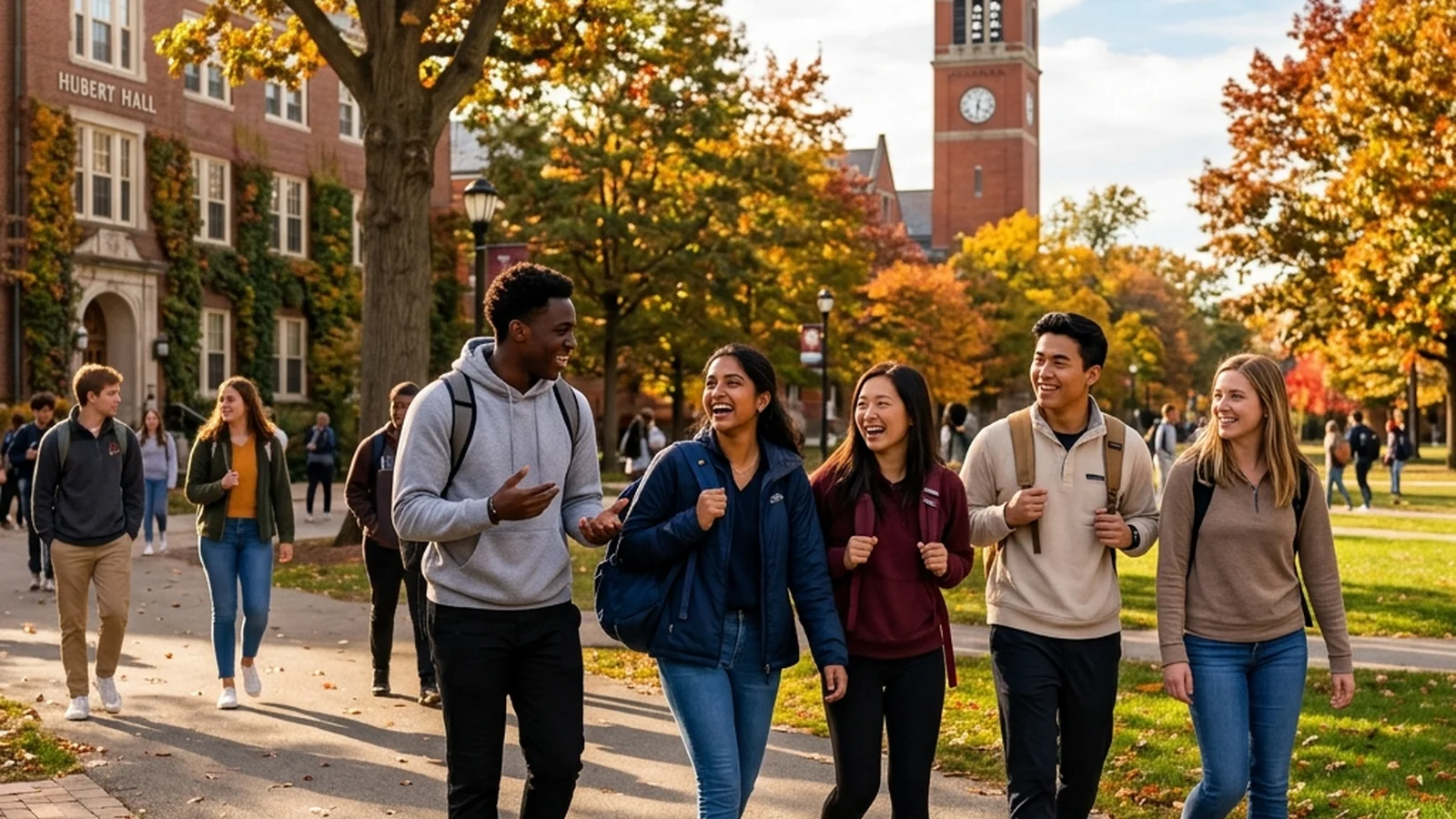
The United States is home to the world's largest concentration of top-ranked universities. With more universities in the global top 100 than any other country, a US degree carries unmatched recognition across industries and borders. From the Ivy League to state university systems, from Silicon Valley-adjacent tech programs to Wall Street feeder schools — the American higher education system offers unparalleled breadth and depth.
For Indian students, the USA remains the top study destination by a significant margin. In 2024, over 330,000 Indian students were studying in the US — the largest international student population from any country. The reason is clear: world-class education, a massive alumni network, and the OPT/STEM OPT pathway that allows up to 3 years of post-graduation work experience.
The F-1 student visa process is different from other countries. There's no points system, no automatic post-study work visa. Instead, there's a consular interview where you must convince a visa officer — in person — that you're a genuine student with the intent and means to study, and strong reasons to return home after your program. That interview is the make-or-break moment, and it's where preparation matters most.
At E3 Immigration, we guide students through the entire journey — from university shortlisting and application submission to I-20 processing, SEVIS registration, DS-160 filing, and consular interview preparation. We know what works because we've done it hundreds of times.
Why Choose the USA?
World's Top-Ranked Universities
8 of the world's top 10 universities are in the US. MIT, Stanford, Harvard, Caltech, Chicago, Columbia, Princeton, and Yale lead every global ranking. Even state universities like UC Berkeley, Michigan, and Georgia Tech are globally respected.
OPT + STEM Extension (3 Years)
After graduation, 12 months of OPT work authorization — extended to 36 months for STEM degree holders. No employer sponsorship needed for OPT. This is the single most valuable post-study benefit in the US system.
Flexible Degree Structure
US universities allow you to explore before specializing. Community college to university transfer pathways. Dual degrees, minors, and interdisciplinary programs offer flexibility no other system matches.
Research & Innovation Hub
The US leads global R&D spending. Access to cutting-edge labs, startup ecosystems, and industry partnerships. PhD funding is among the most generous in the world.
Campus Culture & Networking
American universities offer a complete experience — clubs, sports, career services, alumni networks, and on-campus recruiting by Fortune 500 companies.
Scholarships & Assistantships
Merit scholarships, graduate assistantships (TA/RA), tuition waivers, and fellowship programs. Many STEM master's and most PhD programs offer significant funding.
Understanding the F-1 Student Visa
The F-1 visa is the standard nonimmigrant student visa for academic studies at a US university, college, or English language program. Here's what you need to know:
| Detail | Information |
|---|
| Visa Type | F-1 (Academic Student) |
| Key Document | I-20 (Certificate of Eligibility) — issued by your SEVP-certified university |
| Duration | Duration of Status (D/S) — valid as long as you maintain full-time student status |
| Work Rights | On-campus: 20 hrs/week during term, full-time during breaks. Off-campus: CPT (during studies) and OPT (after graduation) |
| Dependants | Spouse and children under 21 can get F-2 visa. F-2 holders cannot work |
| Application Method | Online DS-160 + in-person consular interview at US Embassy/Consulate |
| Grace Period | 60 days after program completion or OPT to depart the US or change status |
Planning to study in the USA? Get expert guidance from application to visa.
📞 Free Assessment
F-1 Visa Requirements — Complete Checklist
- I-20 Form: Certificate of Eligibility issued by your SEVP-certified university after admission and financial documentation
- Valid passport: Must be valid for at least 6 months beyond your intended stay
- DS-160 confirmation: Online nonimmigrant visa application form — completed and submitted before the interview
- SEVIS fee receipt: $350 fee paid at fmjfee.com. Must be paid before the interview
- Visa application fee: $185 MRV fee paid at the designated bank
- Financial evidence: Proof that you (or your sponsor) can cover tuition + living expenses for at least the first year. Bank statements, fixed deposits, loan sanction letters, sponsor affidavits
- Academic documents: Transcripts, degree certificates, mark sheets, GRE/GMAT scores (if applicable)
- English proficiency: TOEFL iBT (80-100+) or IELTS Academic (6.5-7.0+) — requirements vary by university
- Standardized test scores: GRE (for graduate programs), GMAT (for MBA), SAT/ACT (for undergraduate)
- Passport-size photographs: US visa specifications (2x2 inches, white background)
- Interview preparation: Be ready to explain: why this university, why this program, how you'll fund it, and your post-graduation plans
Step-by-Step: USA F-1 Visa Process
1 Choose Your University & Program
Research universities based on your field, career goals, budget, and location. Consider university rankings, program strength, campus recruiting, location (tech hubs, financial centers), and scholarship availability. Apply to 6-10 universities across reach, match, and safety categories. Use the Common Application for undergraduate and individual portals for graduate programs.
2 Receive Admission & I-20
After acceptance, submit financial documentation proving you can cover at least one year of tuition + living expenses. The university's international student office then issues your I-20 form — this is your key document for the entire F-1 process. Check every detail on the I-20: name spelling, program dates, estimated costs. Any errors must be corrected before proceeding.
3 Pay SEVIS Fee & DS-160
Two separate steps:
- SEVIS fee ($350): Pay at fmjfee.com using your SEVIS ID from the I-20. Keep the receipt
- DS-160: Complete the online visa application form at ceac.state.gov. Upload your photo, answer all questions accurately. Save the confirmation page with barcode
4 Pay MRV Fee & Schedule Interview
Pay the $185 visa application fee (MRV fee) at the designated bank. Then schedule your interview appointment at the US Embassy/Consulate through ustraveldocs.com. Book at your nearest consulate: New Delhi, Mumbai, Chennai, Hyderabad, or Kolkata. Interview slots can fill quickly during peak season (May-August) — book early.
5 Attend the Consular Interview
This is the most critical step. The visa officer will assess:
- Academic intent: Why this university? Why this program? How does it connect to your background?
- Financial capability: Who is funding? Can they genuinely afford it?
- Ties to India: What brings you back? Family, property, career plans in India
- Non-immigrant intent: You must demonstrate intent to return after studies (Section 214(b))
6 Receive Visa & Travel
If approved, your passport with the F-1 visa stamp is returned via courier (3-5 business days). You can enter the US up to 30 days before your program start date (as listed on the I-20). Upon arrival, carry your passport, visa, I-20, SEVIS receipt, financial documents, and admission letter. Report to your university's international student office within the first week to complete check-in.
USA Student Visa Costs & Fees
| Component | Cost |
|---|
| SEVIS Fee (I-901) | $350 (₹29,000) |
| DS-160 Visa Application Fee (MRV) | $185 (₹15,400) |
| TOEFL iBT | $190-$210 (₹16,000-17,500) |
| GRE General Test | $220 (₹18,300) |
| GMAT (for MBA) | $275 (₹22,900) |
| University Application Fees (per university) | $50-$100 (₹4,200-8,300) |
| Credential Evaluation (WES/ECE) | $100-$200 (₹8,300-16,600) |
US University Tuition Fees — What to Expect
| University Type | Undergraduate (per year) | Graduate (per year) |
|---|
| Ivy League / Top Private | $55,000-$65,000 | $50,000-$75,000 |
| Top Public Universities | $30,000-$45,000 | $25,000-$50,000 |
| Mid-Range Universities | $20,000-$35,000 | $20,000-$35,000 |
| Community Colleges (2-year) | $8,000-$15,000 | — |
| MBA Programs | — | $40,000-$80,000 (Wharton, HBS, Stanford at top end) |
Cost-Saving Strategy: Consider starting at a strong public university (University of Texas, Arizona State, SUNY, University of Illinois) instead of private universities. Tuition can be 40-50% lower with comparable program quality. Graduate assistantships (TA/RA) at research universities can cover tuition + provide a monthly stipend of $1,500-$2,500.
OPT & STEM OPT — Your Post-Study Work Pathway
This is the policy that makes studying in the USA a career investment, not just an education expense. The Optional Practical Training (OPT) program gives you:
No Sponsorship Needed • 12-36 Months • Any US Employer
OPT + STEM Extension
After completing your degree, you can work in the US for 12 months under OPT. If your degree is in a STEM field (science, technology, engineering, mathematics), you get an additional 24-month extension — totaling 36 months (3 years) of work authorization.
- Work for any US employer in a field related to your major
- No employer sponsorship required during OPT
- Apply for H-1B work visa during OPT period for long-term employment
- STEM OPT requires employer enrollment in E-Verify
After OPT: If your employer sponsors you for an H-1B work visa, you can continue working in the US. H-1B is valid for 3+3 years and can lead to green card sponsorship — though the timeline for Indian nationals is significantly longer due to per-country caps.
STEM Extension
+24 months
Total Work Rights
36 months
Top Subjects & Career Outcomes
| Subject Area | Popular Programs | Top Universities | Starting Salary |
|---|
| Computer Science | MS CS, AI/ML, Data Science | MIT, Stanford, CMU, UC Berkeley | $90K-$150K |
| Business & MBA | MBA, MS Finance, Analytics | Wharton, HBS, Kellogg, Booth | $80K-$170K |
| Engineering | EE, ME, Biomedical, Civil | MIT, Stanford, Georgia Tech, Michigan | $70K-$110K |
| Healthcare | Public Health, Nursing, Biomed | Johns Hopkins, Harvard, Mayo Clinic | $60K-$90K |
| Natural Sciences | Biology, Chemistry, Physics | Caltech, MIT, Harvard, Princeton | $55K-$85K |
| Liberal Arts | Political Science, Economics | Harvard, Yale, Princeton, Chicago | $50K-$75K |
Scholarships for Indian Students in the USA
| Scholarship | Coverage | Eligibility |
|---|
| Fulbright-Nehru Fellowship | Full tuition + living + travel | Indian citizens, master's and doctoral programs |
| Inlaks Shivdasani Scholarship | Up to $100,000 | Indian nationals under 30, top-50 US universities |
| Tata Scholarship (Cornell) | Full financial aid | Indian undergraduates at Cornell University |
| Graduate Assistantships (TA/RA) | Tuition waiver + $15K-$30K/year stipend | Strong academic profile, research experience (primarily STEM PhD/MS) |
| University Merit Awards | $5,000-$25,000+ | Varies — GPA, test scores, extracurriculars |
For STEM graduate programs, research/teaching assistantships are the most common and substantial form of funding. We help students identify funded programs and craft strong applications to maximize assistantship offers.
USA vs. Other Study Destinations — Quick Comparison
| Factor | USA | Canada | UK | Australia |
|---|
| Master's Duration | 2 years | 1.5-2 years | 1 year | 1.5-2 years |
| Post-Study Work | 1-3 years (OPT/STEM) | Up to 3 years (PGWP) | 2 years (Graduate Route) | 2-4 years |
| Tuition (approx.) | $20K-$55K/year | CAD $15K-$35K/year | £15K-£30K/year | AUD $25K-$45K/year |
| Path to PR | Difficult (H-1B → Green Card, 5-10+ years) | 1-2 years (CEC/PNP) | 5 years (Skilled Worker) | 2-4 years |
| Interview Required | Yes (in-person) | No (biometrics only) | Sometimes (brief) | No |
| Global Ranking | 8 in top 10 | 2-3 in top 50 | 4 in top 10 | 5-6 in top 50 |
Common Mistakes That Lead to F-1 Visa Refusal
- Section 214(b) refusal: The most common refusal reason. The officer was not convinced you'll return to India after studies. You must demonstrate strong ties — family, property, career plans, and clear intent to use the US degree back home
- Weak financial evidence: Unclear source of funds, insufficient amount, or sponsor documents that don't match claims. Bank statements should show consistent balance, not sudden large deposits
- Poor interview performance: Vague answers about why this university, why this program, or what you'll do after graduation. Memorized scripts are easily detected
- Program-profile mismatch: Switching fields without clear justification (e.g., engineering undergraduate applying for an unrelated master's). The officer needs to see a logical career narrative
- Choosing a low-ranked university without justification: If you have strong academics but chose an unknown university, the officer may question your intent
- Inconsistent documents: Name or date mismatches between passport, transcripts, and I-20. Address inconsistencies in sponsor documents
- Overly prepared: Reading from notes or giving rehearsed answers suggests coaching. Be natural, confident, and honest
Why E3 Immigration for Your USA Student Visa?
The US visa process is unique among major study destinations. There's no points system, no automatic approval based on documents alone. The consular interview puts everything on the line — your academic story, financial readiness, and return intent must come together in a 2-3 minute conversation.
We prepare students for that conversation with the same rigor we bring to the documentation. We review financial evidence for consistency, check I-20 details character by character, run mock interviews with the exact questions US consulates ask, and build a narrative that connects your past education to your chosen program to your future career in India.
From university shortlisting and application strategy to I-20 processing, SEVIS registration, DS-160 filing, and interview coaching — we manage the entire USA study journey. Because when you're investing ₹25-60 lakhs in an American education, your visa application deserves the kind of preparation that leaves nothing to chance.
Frequently Asked Questions
How much does a USA F-1 student visa cost?
The total cost includes: SEVIS fee ($350), DS-160 visa application fee ($185), and biometrics. Additionally, you need to show proof of funds covering first-year tuition plus living expenses. Total upfront visa-related costs are approximately $535 (₹44,000-45,000).
What is the difference between OPT and CPT?
CPT (Curricular Practical Training) allows work during your studies as part of the curriculum — internships, co-ops. OPT (Optional Practical Training) is post-graduation work authorization for 12 months, extendable to 36 months for STEM degree holders.
Can I work while studying in the USA on F-1 visa?
On-campus employment is allowed up to 20 hours/week during the academic year and full-time during breaks. Off-campus work requires CPT authorization through your university. Unauthorized employment can result in visa termination.
What is the SEVIS fee and when do I pay it?
SEVIS (Student and Exchange Visitor Information System) fee is $350 for F-1 students. Pay it online at fmjfee.com after receiving your I-20 but before your visa interview. Keep the receipt — you need it at the interview.
How do I prepare for the US visa interview?
Be clear about why you chose this university and program, how you will fund your education, and your plans after graduation (return to India or OPT). Bring all original documents. Answer honestly and concisely. We provide mock interview sessions to prepare you.
Is it possible to get PR in the USA after studying?
The USA does not have a direct study-to-PR pathway like Canada. After OPT, you would need employer sponsorship for an H-1B work visa, then a green card sponsorship. The process takes 5-10+ years depending on your country of birth and employer.